
Summary
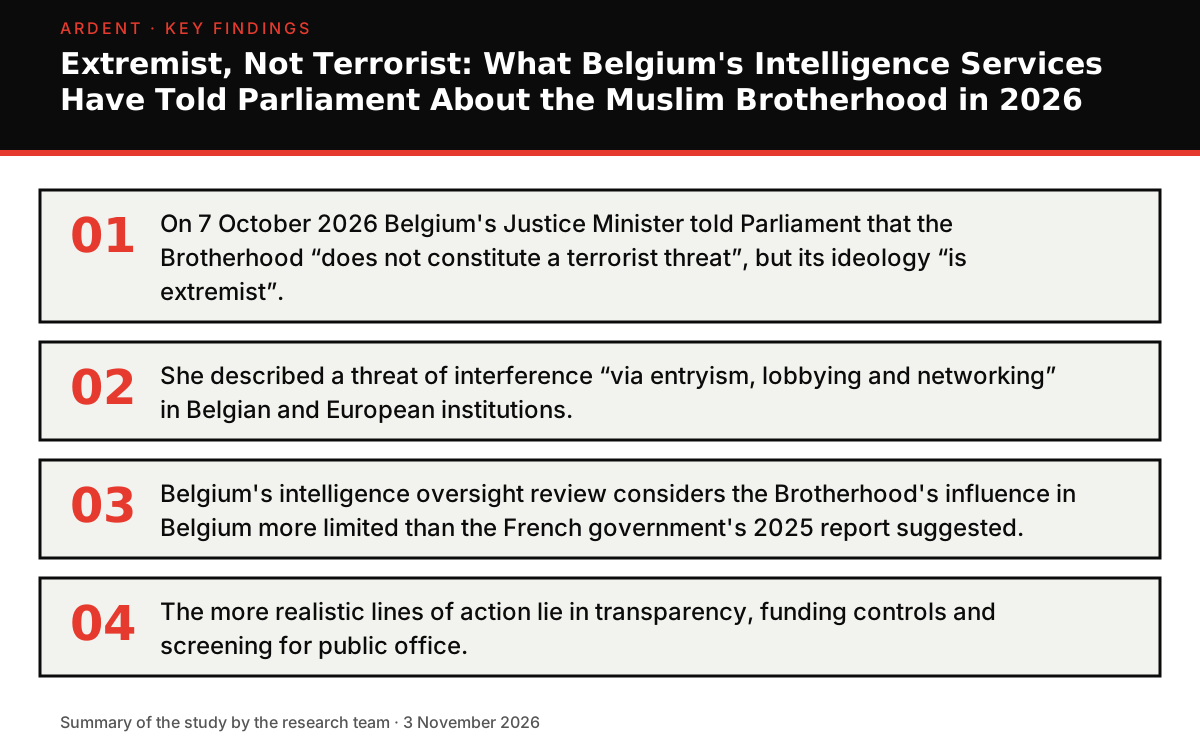
On 7 October 2026, the day before the European Parliament adopted its non-binding resolution on Islamist entryism, Belgium's Minister of Justice, Annelies Verlinden, gave the Chamber of Representatives' Justice Committee the clearest public statement yet of how the State Security Service (Veiligheid van de Staat / Sûreté de l'État, VSSE) assesses the Muslim Brotherhood. In her words, the Brotherhood "does not constitute a terrorist threat" in Europe or Belgium, but its ideology "is extremist", and it poses a threat of interference "via entryism, lobbying and networking" in Belgian and European institutions (Kamer van volksvertegenwoordigers 2026, question 56018916C). She added that the information received from foreign partners over the past year gave no reason to revise the threat assessment.
That answer closely matches the findings of an updated oversight review by the Standing Intelligence Agencies Review Committee (Vast Comité van Toezicht op de inlichtingen- en veiligheidsdiensten, Comité I). The review is dated 17 March 2026 and was public by 1 April 2026, when it was presented to the Chamber's oversight committee in closed session and reported in the press (Comité R/I 2026; Clerix 2026). Taken together, the two documents give a rare official picture of how a European intelligence community that sits at the heart of EU institutions sees the Brotherhood. It considers the movement extremist and engaged in influence operations, but not a terrorist actor. It also considers the Brotherhood's influence in Belgium to be more limited than the French government's 2025 report suggested.
This matters for the debate the European Parliament has now opened. The Parliament's resolution asks the Council to list Brotherhood-linked entities and individuals on the EU terrorist list "where the criteria under Common Position 2001/931/CFSP are met" (European Parliament 2026, P10_TA(2026)0342; European Parliament Legislative Observatory 2026). The Belgian assessment suggests that, at least in the member state hosting most EU institutions, those criteria are unlikely to be met by the intelligence services' own reading. The more realistic lines of action lie in transparency, funding controls and screening for public office.
1. Why Belgium, and why now
Belgium came under particular scrutiny after the French government's report Frères musulmans et islamisme politique en France was reported in the press on 20 May 2025. As the Comité I summarises it, the French report described Belgium as a "European crossroads" of the Brotherhood movement, with very considerable influence over European institutions, and referred to certain Brussels municipalities where Islamist social control "seems almost total" (Comité R/I 2026, executive summary, translating the French report). This prompted questions in the Chamber of Representatives between May and July 2025, including on what the French report meant for Belgium. Two of them concerned the Collectif pour l'Inclusion et contre l'Islamophobie en Belgique (CIIB): Denis Ducarme's question of 10 July 2025 on its alleged infiltration by the Brotherhood (56000892P) and Alexander Van Hoecke's question of 16 July 2025 on Federal Public Service Justice subsidies to it (56006927C) (Comité R/I 2026, n. 13). According to the Comité I, the CIIB was formerly the Collectief tegen Islamofobie in België (CTIB), a non-profit association founded in Brussels in 2014 to combat Islamophobia (Comité R/I 2026, n. 35).
On 10 July 2025 the Chamber's oversight committee for the police and intelligence review bodies asked the Comité I to update its 2021 review (reference 2021.287) of how the intelligence services monitor the Brotherhood, and to assess what the services knew about the Belgian material in the French report (Comité R/I 2026, para. 7). The updated review is dated 17 March 2026.
The question returned to Parliament in autumn 2026. On 7 October 2026 Koen Metsu of the New Flemish Alliance (N-VA) asked the Justice Minister for an update in the light of the European debate, including the French push for an EU terrorist listing and a report he described as a European Parliament report of 20 November 2025 that calls the Brotherhood a danger to peace and security in Europe (Kamer van volksvertegenwoordigers 2026, 03.01). No Parliament report of that date exists. He appears to have meant Unmasking the Muslim Brotherhood: Brotherism, Islamophobia and the EU by Florence Bergeaud-Blackler and Tommaso Virgili. The European Conservatives and Reformists (ECR) Group commissioned this report, and it states that it does not represent the official position of the European Parliament (Bergeaud-Blackler and Virgili 2025). It was launched at the Parliament on 19 November 2025 (EU Today 2025). The "danger to peace and security" wording is Mr Metsu's own. The European Parliament adopted its resolution the following day, 8 October, by 381 votes to 167, with 15 abstentions (European Parliament Legislative Observatory 2026).
2. What the Belgian services say
2.1 A shared definition
One of the Comité I's 2021 recommendations was that the services agree a common definition. That has now been done. In 2022 the VSSE convened Belgian security and intelligence partners to agree one, and since 2024 the VSSE and the General Intelligence and Security Service of the armed forces (Algemene Dienst Inlichting en Veiligheid, ADIV) have monitored the Brotherhood jointly through the Platform Counter Extremism & Counter Terrorism (PFCECT), with the VSSE as lead service (Comité R/I 2026, executive summary and n. 4; paras 19–20).
The agreed definition describes the Brotherhood as a socio-political Islamic movement founded in Egypt in 1928, whose long-term aim is a system in which "the religious norm regulates all aspects of the life of the individual, society and the state". In Europe, according to the definition, the Brotherhood rejects violence, including terrorism, and works instead through preaching, education, socio-political activism, infiltration and lobbying, presenting itself as the voice of Muslims before national and European institutions. Its public image of moderation "sometimes contrasts" with an internal discourse that rejects secularism and treats religious norms as superior to national law (Comité R/I 2026, para. 20).
The services distinguish between sworn members, who have taken an oath of allegiance and work towards objectives set by the hierarchy, and fréristes, who promote the ideology without being part of the organisation (Comité R/I 2026, executive summary).
2.2 Scale
The Comité I's review records the PFCECT's estimate that about a hundred individuals in Belgium are actively involved in spreading Brotherhood ideology, and that there are "a few dozen" organisations of the Brotherhood tendency. The review states that, according to the services, the Ligue des Musulmans de Belgique represents the "national" branch of the Brotherhood in Belgium (Comité R/I 2026, executive summary). This is the services' characterisation as reported by the Comité I; it is not a finding of a court.
The Minister did not give numbers on 7 October. She said only that "several organisations" in Belgium "structurally belong to the Muslim Brotherhood tendency", are active in spreading the ideology or lobbying, and have institutional or semi-institutional links to the international, regional or national structure. In answer to a second question she listed their activities as religious education, conferences, preaching, fundraising, networking and lobbying of institutions and governments, and said the VSSE does not comment on individual persons or organisations (Kamer van volksvertegenwoordigers 2026, 03.02 and 04.02).
2.3 Threat: extremist, not terrorist
The services' position, as recorded by both sources, has three parts:
- No terrorist threat. The Brotherhood does not currently represent a direct threat of violent action in Belgium or against Belgian interests (Comité R/I 2026, executive summary). The Minister said that "most European intelligence services" share the view that it is not a terrorist threat (Kamer van volksvertegenwoordigers 2026, 03.02).
- An extremist threat. Its ideology is classed as extremist. In the short and medium term its discourse contributes to "a climate of segregation and polarisation", which in turn is "a fertile breeding ground for radicalisation" (Kamer van volksvertegenwoordigers 2026, 03.02).
- Interference. Members conceal or deny their membership and present themselves as independent entities in order to influence policy. Because of this lack of transparency, the Minister said, "there is also interference" (Kamer van volksvertegenwoordigers 2026, 03.02). The PFCECT also identifies risks to political institutions from influence over decision-making, the securing of public funding and damage to the authorities' reputation where links exist (Comité R/I 2026, executive summary).
The Coordination Unit for Threat Analysis (Coördinatieorgaan voor de dreigingsanalyse, OCAD) takes a narrower view, unchanged since 2021. It identifies no direct threat that could lead to a raised threat level in the short or long term (Comité R/I 2026, executive summary).
2.4 A movement under strain
The most newsworthy findings in the Comité I review concern trends. The PFCECT has observed that the Brotherhood faces financial difficulties because foreign support has declined; that new online religious education initiatives are emerging; and that pressure from the French authorities has led some actors to relocate to Belgium. It expects the threat to remain stable over the next five years, and judges that the Brotherhood's influence "has decreased considerably in recent years" (Comité R/I 2026, executive summary).
On the French report, the Belgian services' analysis "does not entirely correspond". The PFCECT sees no indications of Islamist control being exercised in Belgium, and considers the Brotherhood's influence in Belgium more limited than the French report suggests (Comité R/I 2026, executive summary).
2.5 Transnational links
On 7 October the Minister also said that Brotherhood members living in Belgium "apparently maintain ties" with like-minded individuals and organisations in Turkey, travelling there occasionally for organisational meetings or educational activities. The VSSE is aware that the Brotherhood organises conferences in the Balkans and Turkey with a risk of recruiting new members (Kamer van volksvertegenwoordigers 2026, 04.02).
Asked by Mr Metsu about the Maydan movement, which he linked to a conference held in The Hague on 16 September 2026, the Minister said the VSSE has no information that Maydan members reside in Belgium. She also made a point that bears directly on calls for EU listing: the VSSE does not automatically investigate people labelled terrorists by foreign states, "because that sometimes happens purely on the basis of their opposition activities" (Kamer van volksvertegenwoordigers 2026, 04.02). The allegations about Maydan and named individuals in Mr Metsu's written question are his own and were not confirmed by the Minister; this study does not repeat them as fact.
3. Unfinished business
The Comité I found that four of its 2021 recommendations had been followed up: stronger cooperation between the services and their partners; awareness-raising by the VSSE among authorities and the public; an ADIV evaluation of the resources it devotes to countering Brotherhood influence within Defence; and internal ADIV briefings for security officers (Comité R/I 2026, executive summary). The ADIV had already judged in 2021 that there was a risk of Brotherhood infiltration of Defence.
One recommendation remains open. The Comité I had no information to determine whether there is now a prior check of integrity, loyalty and discretion before appointment to certain public posts, such as government commissioner or military chaplain (Comité R/I 2026, executive summary). The original 2021 review followed an inquiry into how the VSSE had handled the case of a former government commissioner (Comité R/I 2026, para. 2). Of everything in the Belgian record, this gap is the one most directly relevant to the entryism concerns that the European Parliament has raised.
4. Assessment
The Belgian record cuts across both sides of the European debate.
For those who describe the Brotherhood as a benign civil-society current, the record is uncomfortable. A national intelligence community, speaking through its minister in Parliament, classes the ideology as extremist, describes concealment of membership as a method, and calls the resulting lack of transparency interference.
For those who want an EU terrorist listing, the record is equally uncomfortable. The same services, which watch the EU institutions at close range, say the Brotherhood is not a terrorist threat, that most European partners agree, and that foreign terrorist labels can be politically motivated. Under Article 1(4) of Council Common Position 2001/931/CFSP, the EU list must be based on precise information showing that "a decision has been taken by a competent authority" (a judicial authority or its equivalent) on investigations, prosecution or conviction for terrorist acts (Council of the European Union 2001; see also 2eu.brussels 2026). Belgium's assessment makes such a decision there unlikely for the movement as a whole.
The practical agenda that follows is narrower but more achievable:
- Screening for public office. Belgium should confirm whether the outstanding Comité I recommendation on prior integrity checks for sensitive appointments has been implemented.
- Transparency over funding and representation. The VSSE's own emphasis on concealed membership points to disclosure rules for organisations that seek public funds or institutional access, rather than proscription.
- Watching displacement. If, as the PFCECT reports, French pressure has pushed some actors into Belgium, cross-border monitoring between Paris and Brussels matters more than any single national measure.
- Precision in Brussels. The European Commission's response to the Parliament's resolution should take account of member-state threat assessments such as Belgium's, which separate extremism and interference from terrorism.
5. Limits of this study
The Comité I review is dated 17 March 2026 and was made public by 1 April 2026, when it was presented to the Chamber's oversight committee in closed session and reported by Knack (Clerix 2026). We have read the Dutch-language version only and have translated quotations ourselves. The Minister's statements are taken from the provisional integral record of the Justice Committee (CRIV 56 COM, 7 October 2026), which may be corrected in the final version.
References
2eu.brussels. 2026. "Parliament Calls for Funding Checks and Assessment of Muslim Brotherhood-Linked Entities for EU Terrorist List." 9 October 2026. https://2eu.brussels/en/news/parliament-calls-for-funding-checks-and-assessment-of-muslim-brotherhood-linked-entities-for-eu-terrorist-list.
Bergeaud-Blackler, Florence, and Tommaso Virgili. 2025. Unmasking the Muslim Brotherhood: Brotherism, Islamophobia and the EU. Brussels: European Conservatives and Reformists Group. https://ecrgroup.eu/files/Unmasking_the_Muslim_Brotherhood_(2).pdf.
Clerix, Kristof. 2026. "Belgische inlichtingendiensten spreken Frans rapport over Moslimbroeders tegen." Knack, 1 April 2026. https://www.knack.be/nieuws/belgie/belgische-inlichtingendiensten-spreken-frans-rapport-over-moslimbroeders-tegen-geen-aanwijzingen-dat-er-in-belgie-sprake-is-van-controle-vanwege-islamisten/.
Comité R/I (Vast Comité van Toezicht op de inlichtingen- en veiligheidsdiensten). 2026. Moslimbroeders: Actualisering van het toezichtonderzoek 2021.287. Ref. 2025.319, 17 March 2026. Brussels: Comité I. https://comiteri.be/images/pdf/onderzoeksverslagen/TO%20Moslimbroeders_UNCLASS_NL_final%20Commission.pdf.
Council of the European Union. 2001. "Council Common Position of 27 December 2001 on the Application of Specific Measures to Combat Terrorism (2001/931/CFSP)." Official Journal of the European Communities L 344, 28 December 2001. https://eur-lex.europa.eu/eli/compos/2001/931/oj/eng.
EU Today. 2025. "Brussels Rally Calls for EU to Designate Muslim Brotherhood a Terrorist Organisation." November 2025. https://eutoday.net/brussels-muslim-brotherhood-terrorist-organisation/.
European Parliament. 2026. "European Parliament Resolution of 8 October 2026 on the Need for an EU Strategy to Counter Islamist Entryism and the Influence of the Muslim Brotherhood Network (2026/2868(RSP))." P10_TA(2026)0342. https://www.europarl.europa.eu/doceo/document/TA-10-2026-0342_EN.html.
European Parliament Legislative Observatory. 2026. "The Need for an EU Strategy to Counter Islamist Entryism and the Influence of the Muslim Brotherhood Network, 2026/2868(RSP): Document Summary." 8 October 2026. https://oeil.europarl.europa.eu/oeil/en/document-summary?id=1919148.
Kamer van volksvertegenwoordigers. 2026. Integraal verslag, Commissie voor Justitie, woensdag 7 oktober 2026, namiddag (CRIV 56 COM, provisional). Questions 56018916C and 56019044C/56019045C by Koen Metsu to Annelies Verlinden. Brussels: Chamber of Representatives. https://www.dekamer.be/doc/CCRI/pdf/56/ic472x.pdf.